Unmasking the Domestic Abuser in the Church

Author: Jeff Crippen Page 40 of 88

The Tentative Love of Counterfeit Brethren

One of the qualities of counterfeit “brethren” is that you always sense their relationship/friendship/love they claim for  us is tentative. You may not really be able to verbalize it right away, but you feel it. There is always an “if.” If you say the wrong thing…then. If you do something….then. All of this is of course very characteristic of a domestic abuser/sociopath.

But these fakes often creep into the church posing a Christians. I know that over all these years the “if” has always been hanging there like a club. And I wasn’t imagining it because inevitably the “then” on their part kicks in. They hate. They abandon. They revile and slander. Seemingly overnight.

But where there is the real article, there is no “if.” We love one another. We forgive one another. We forbear with one another.

Eph 4:31-32 Let all bitterness and wrath and anger and clamor and slander be put away from you, along with all malice. (32) Be kind to one another, tenderhearted, forgiving one another, as God in Christ forgave you.

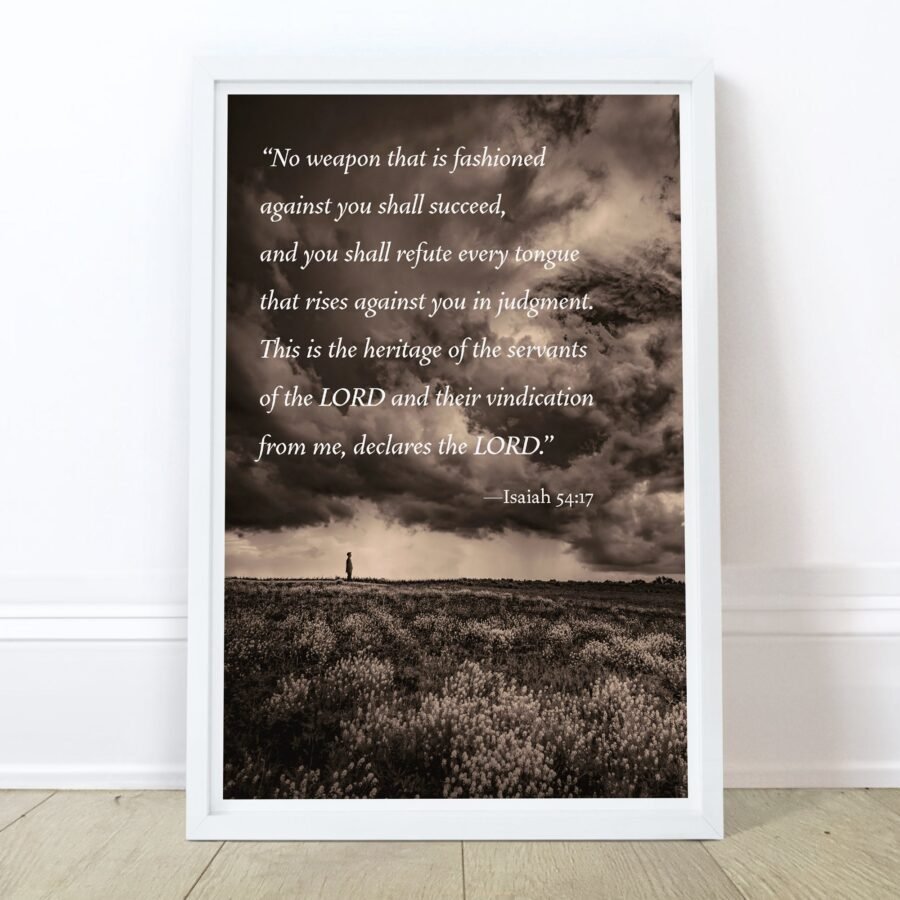
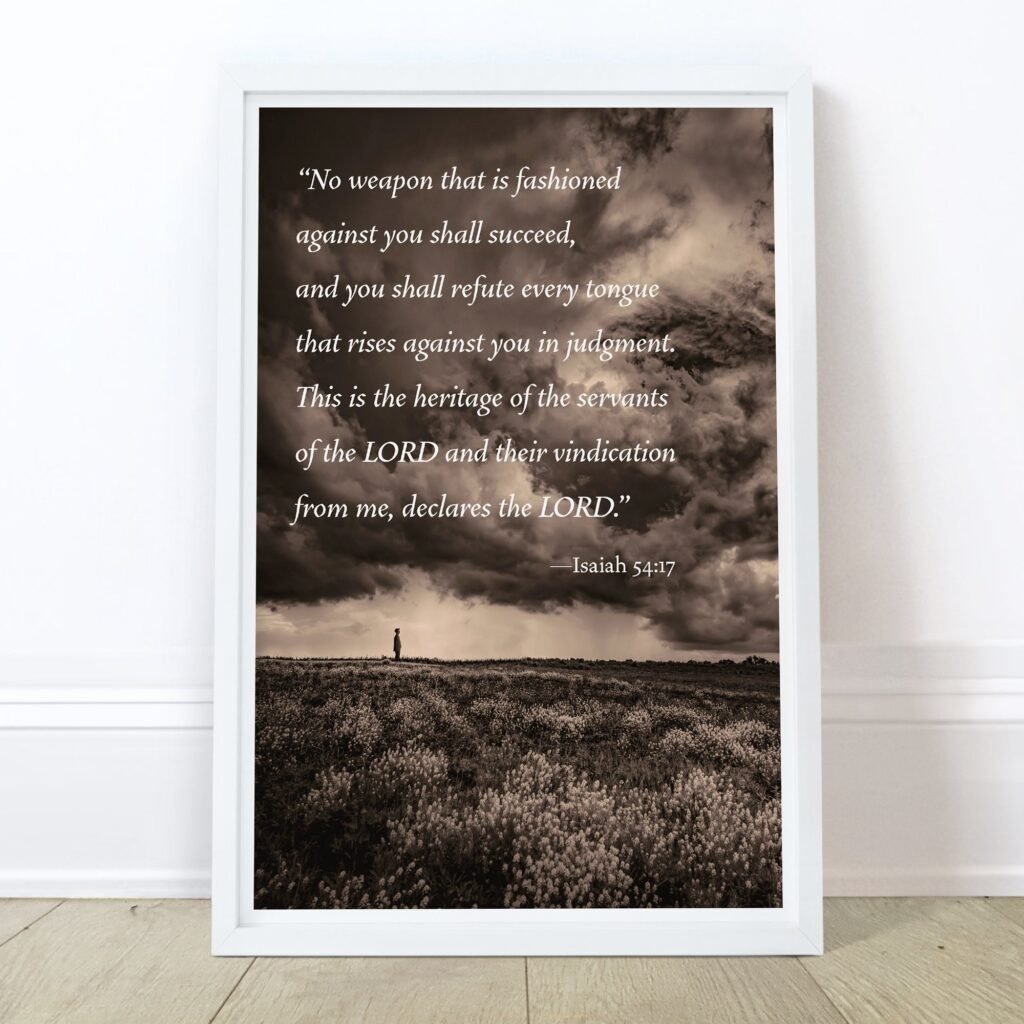
A Powerful Poster that will Inspire You – Isaiah 54:17

Our friends the Austins at graphicspaces.com created this poster for me. We have it on the wall now at Christ Reformation Church where it is a great reminder of this certain promise of God. You can order one (free shipping) from them at –

https://www.graphicspaces.com/pages/our-story-history

Being Abused does not Justify Abusing

Rom 12:17 Repay no one evil for evil, but give thought to do what is honorable in the sight of all.

1Th 5:15 See that no one repays anyone evil for evil, but always seek to do good to one another and to everyone.

1Pe 3:9 Do not repay evil for evil or reviling for reviling, but on the contrary, bless, for to this you were called, that you may obtain a blessing.

I hope that all of you know by now that I fully understand the typical false nonsense laid upon victims of abuse that twists the Bible’s teaching on things like forgiveness, mercy, reconciliation, and so on. And I also, like all of you, hunger and thirst for righteousness, for justice, and even for God’s vengeance upon the wicked.

But I want to take the time in this article to be sure that in holding to these biblical and right positions, no one takes what we say here as grounds for doing to others what has been done to them. I am afraid that there are people and books floating around out there that justify such sin. They say things like “hurt people hurt people” and the implication is that somehow we are to give hurt people a pass when they hurt others. Not true. Nope. Having been the target of evil does not give me license to launch evil upon others.

Years ago there was a lady in our church who had gone through a bad marriage – I don’t know the details. But this lady was mean. She was demanding. And when she did not get her way she threw anger fits. She has hated me ever since the day I confronted her about her sin and told her that it had to stop. Her adult son took me aside one Sunday and said “we know my mother is a bitter woman. But we all have decided to love her anyway.” By “loving” her of course he meant “we ignore her nastiness and let her get away with it.” That is not love.

All of us have been abused by wicked people. Most of you who follow this blog have experienced deep, even intense evil and you have suffered greatly. The Lord knows and He will render His perfect justice to your persecutors. But this does not give us the right to be mean, to be seeking personal revenge, to snap at and lash out at anyone who does something we don’t like.

One form of this sinful nastiness is to become a person who hates men (or women) as a result of being wronged. I know such people. They have been abused by a man, so they resolved to hate all men. And they teach others to hate men. Where do you find that kind of thing anywhere in the Bible? You don’t. We are to love one another – love the brethren. That means loving both men and women. What are we doing to our children if we teach them such hatred? Girls, never trust a man. Men are evil.

Well, think that through. The Lord Jesus Christ is a man – the God-Man. While God is Spirit and in that sense without gender, nevertheless the Bible refers to Him as Father, as “He” and as “Him.” Can you see that a person who is taught to hate men is going to have a pretty tough time loving God?

We abused the Lord Jesus Christ. Our sins put Him on the cross. And yet He set His love upon us. Thankfully, He did not choose to hate all human beings.

So let’s examine ourselves carefully in this regard. Perhaps someone reading this has been taught to hate men – or if your abusere was a woman, to hate all women. And maybe you, as a result, have become, well, mean. That is a trap. It does not lead to anywhere good. And it is sin. Ask the Lord to show it to you, grant you repentance, and set you free.

They Go too Far — Watch Out for Leaders who Have a Book or a Word for Every Aspect of Your Life

1Co 4:3-6 But with me it is a very small thing that I should be judged by you or by any human court. In fact, I do not even judge myself. (4) For I am not aware of anything against myself, but I am not thereby acquitted. It is the Lord who judges me. (5) Therefore do not pronounce judgment before the time, before the Lord comes, who will bring to light the things now hidden in darkness and will disclose the purposes of the heart. Then each one will receive his commendation from God. (6) I have applied all these things to myself and Apollos for your benefit, brothers, that you may learn by us not to go beyond what is written, that none of you may be puffed up in favor of one against another.

You are looking at just PART of the books that John Piper has written. Recently a member of our church packed them all up and brought them to me. Well, I am glad to report that the person saw Piper’s errors some time ago. I am keeping these for now as we research his books for false teaching, specifically his works-based false gospel.

But here is my point, and this is why I put this picture here. One of the characteristics of an errant preaching, writing, teaching ministry is that, as Paul wrote to the Corinthians, the person goes “beyond what is written.” That is to say, they teach authoritatively (supposedly with Scriptural authority) on just about every nut and bolt of life. They tell you very specifically “how to” –

  • Have sex
  • Educate your children
  • Arrange your meals
  • Use your leisure time
  • Surf the web
  • Do your work
  • Purchase a car
  • Get (or not get) a divorce

And on and on and on they go. I suppose we could add another “how to” – they tell you how to think.  And if they are really good at doing all of this in a charismatic and convincing manner, they gain a following (often a very large following) of people whose experience of “Christ” goes no further than, “well, let’s see what John Piper says about that.” This is dangerous.

Yes, God’s Word can be applied to every aspect of our lives, and should be. Whatever we do, Paul says we are to do to the glory of God. But in walking with Christ, each individual Christian is indwelt and led by the Holy Spirit. The Spirit enables us to take the “condensed soup” of Scripture, expand upon it properly, and apply it to our own lives. It is the proper task of a pastor or theologian to assist us in understanding God’s Word with the goal (Ephesians 4:11ff) of seeing us grow up into the fullness of Christ so we don’t keep getting knocked off course by every trickster that comes along.

But so many go too far. They go beyond what is written in Scripture. In doing so, they quite often take us back under the law and bring us into bondage. Or they swing quite the other direction and lead us down their road of libertinism (I’m ok, you are ok, most anything is ok. Have a good time).

This going beyond what is written is often put into play when church leaders or other Christians or famous writers of enough books to fill a big box or two, begin to feel that they need to inject themselves into the lives of their people, control them, tell them…function as their conscience and even try to be the Holy Spirit. Many of you have had this happen. Here comes Mr. or Mrs. “builder of a fence around the Law so we are sure no one sins” poking their nose into your life. “You know, I noticed that you said/did such and such. I don’t agree with what you said/did. I will tell you what you should say/do.” And this very same thing can be done from the pulpit or in the myriads of books that the more skilled Holy Spirit players write.

I am not saying that we are to be total rebels and cast off any accountability to one another. If a professed Christian is abusing his wife (and he isn’t a Christian if he is), that guy needs to be confronted and held to accounts. Evil needs to be exposed. Error in teaching must be corrected. But what I am addressing here is specifically this business of “going beyond what is written” and judging one another in areas that the Lord has told us all to just cool our jets and wait until the Day comes when He will sort it all out.

There is something just not right – scary even – about one human being writing over 60 books, many of which are “how-to books” and even “how you must think” books. Books that come at you from the angle of “Look at this new thing I have discovered in the Bible.” Or worse, they present a “new thing” claiming that it is still just the orthodox old thing, but in new wrappings. What kind of a person is going to be produced if they were to read all 60 of John Piper’s books? Or 30 of them? Or 20? Or 10? (I sound like Abraham dealing with God over Sodom:).

Why are we doing so?  That is, why are we focusing on John Piper in these posts?  Because of his huge influence on so many Christians and their thinking. Because this influence has contributed to creating an environment in our churches that we at this blog have to work to expose every single day. An environment that oppresses the weak and enables the wicked. A works-based twisting of the gospel will do that every time because it takes our eyes off of the finished, glorious work of Jesus Christ and sets our focus upon what we must DO to be right with God.

1 Cor 4:6 I have applied all these things to myself and Apollos for your benefit, brothers, that you may learn by us not to go beyond what is written, that none of you may be puffed up in favor of one against another.

Do as they say, Not as they do?? What does this mean?

Mat 23:1-3 Then Jesus said to the crowds and to his disciples, (2) “The scribes and the Pharisees sit on Moses’ seat, (3) so do and observe whatever they tell you, but not the works they do. For they preach, but do not practice.

Have you ever read these words of Jesus and been confused? I have. Wouldn’t you think that we should disregard what such hypocrites say as well as what they do?

Well, recently a commenter on this blog gave an account of how he was taken in by a similar hypocrite and his comment I believe sheds some light on why Jesus said what He said:

My wife and I have a friend that has been at our home the past three days. A family that were pillars in the church….married over 50 years….the husband a mentor to me when I was a young husband and father….who come to find out, behind closed doors in the home abused his wife and children. So instead of a home filled with the love of Jesus it was a house of horrors. Pray for the family. Pray for their safety especially the wife. Pray for wisdom.

So what you are telling us Pastor Crippen is even though I broke bread with this man…studied the Word together, prayed together, shared our deapest thoughts and concerns…learning to be a godly husband and father with him…he did this as a wolf, as a fraud, as a hypocrite? I should be weeping losing a friend. But I find myself not…instead there is this steadfast anger in my soul….not a raging anger….just a steadfast mad….might it be righteous anger? I am now doubting he never became a new creation in Christ as he claims.

Thank you Wade, for sharing this.

The scribes and Pharisees “sat in Moses’ seat.” This brings to our minds how Ezra read the Scriptures to the people after they returned to the land and apparently that tradition continued in the synagogues as some teacher would read and expound the Law given through Moses to the people. We see it in Jesus’ actions at Nazareth:

Luk 4:16-20 And he came to Nazareth, where he had been brought up. And as was his custom, he went to the synagogue on the Sabbath day, and he stood up to read. (17) And the scroll of the prophet Isaiah was given to him. He unrolled the scroll and found the place where it was written, (18) “The Spirit of the Lord is upon me, because he has anointed me to proclaim good news to the poor. He has sent me to proclaim liberty to the captives and recovering of sight to the blind, to set at liberty those who are oppressed, (19) to proclaim the year of the Lord’s favor.” (20) And he rolled up the scroll and gave it back to the attendant and sat down. And the eyes of all in the synagogue were fixed on him.

Hypocrites, in other words, are very capable of stating scriptural doctrine. Of quoting Bible verses. So when these Pharisees in the synagogues read Moses’ words, Jesus told the people to do whatever the Pharisees “told them to do,” ie, whatever the scriptures said. BUT the application of the Law by the Pharisees is what the people were to reject. Because these wicked counterfeits warped and twisted the real meaning and spirit of the Law.

Remember that people in Jesus’ day, just as so many people have been down through the centuries, did not have personal access to the Scriptures. People didn’t carry their Bible around and I would imagine that myriads of people wouldn’t know how to read it if they did. So they were dependent upon their synagogue leaders to read God’s Word to them. THAT is the part Jesus is telling them to hear and do. But the actual practical interpretation and handling of it was botched and was to be rejected. Jesus was upholding the Law as God’s Word, but was denouncing the ways the Pharisees and scribes twisted and perverted it.

And that is what Wade (author of the comment above) has experienced in this guy whose mentoring even benefitted him. I have experienced the same thing more than once, only to learn later that the person I thought was genuine was a fraud. And as I looked closer, I could see how such people misapplied and twisted God’s Word.

You can think of many examples of this very thing. Think for instance of the “godly” and saintly and wise preacher who was well-known and appreciated by thousands, and then is found out to have been living a sham all along. Did we benefit from his “ministry”? Yes, in many ways. To the extent he was truly communicating God’s Word in the Bible to us, we did. BUT, we had better go back now and closely examine how we might have bought into some of his applications of Scripture because in some way ALL of his applications are going to be tainted.

Really, I think what Jesus is saying is simply what we refer to as “sola scriptura” (if I spelled the Latin correctly). Scripture alone. Yes, God gives us pastors and teachers and so on (Ephesians 4), but our sole authority for what we believe is the Bible alone. We err greatly if we make any human being our authority.

Practically, what will inevitably happen when we are dealing with a hypocrite, is that if we will apply Jesus’ instruction here, it will not be long before the hypocrite hates us and leaves us. Because hypocrites demand that we do as they do. When we make Scripture our only authority and thus do what God says to do, the counterfeit will be incensed – and exposed.

Challenging the No Divorce for Abuse Fortress Which Has Been Raised Up Against the Knowledge of God

I continue to hammer on this business of abuse as grounds for divorce because frankly I see it as the non-negotiable issue in this battle against abuse and abusers hiding in the church and being enabled by pastors and Christians.  As long as anyone refuses to acknowledge that a victim of abuse has a right before God to divorce their abuser, then injustice is still going to be effected by them against victims.  They will keep right on insisting that victims remain in cruel bondage in Egypt.

Exodus 21:7-11 ESV “When a man sells his daughter as a slave, she shall not go out as the male slaves do. If she does not please her master, who has designated her for himself, then he shall let her be redeemed. He shall have no right to sell her to a foreign people, since he has broken faith with her. If he designates her for his son, he shall deal with her as with a daughter. If he takes another wife to himself, he shall not diminish her food, her clothing, or her marital rights. And if he does not do these three things for her, she shall go out for nothing, without payment of money.

1 Corinthians 7:15 ESV  But if the unbelieving partner separates, let it be so. In such cases the brother or sister is not enslaved. God has called you to peace.

A Christian woman was married to a wicked man for 25 years.  Although the husband had vowed to love and cherish her until death parted them, he never did.  His abuse of his wife might be called mere passivity.  He just did not care.  He was not available for a real relationship, focused himself on his own pleasures, ate the meals she cooked with unthankfulness and assumed he was as good as the next guy.

Is this abuse?  “Well, yes.”  Does this man’s wife have biblical grounds to divorce him?  “Well, no,” you say? “No adultery.  No desertion = no divorce.  It’s that simple.”

Then let me complicate it for you.

A Christian woman was married to a wicked man for 25 years.  He too had vowed to love and cherish her until death parted them, but neither did he.  He was more active in the abuse of his beloved.  He regularly used cutting words until her sense of self had almost died.  He mocked her efforts to beautify the home and told her she was a pathetic mother (though he never lifted a hand to help with either the house or the children).  Well, at least with the unpleasant aspects of child-rearing, like discipline or helping with schooling.  He was not a drunk.  He went to work regularly, but he controlled and begrudged every dollar she spent.  And sometimes he would rage.  Throw things.  Smash a wall.  Scream and yell about how stupid she was to do….whatever.

Is this abuse?  “Well, yes, of course it is!”  Does this man’s wife have biblical grounds to divorce him?  “Hmmmm….no.  No adultery.  No desertion.  No divorce.  Still pretty simple.”  And would you be willing to explain that to her?  That GOD has bound her to this man and that if she divorces him she will be guilty of a most heinous sin?  “Boy, that wouldn’t be easy, but I would have to do it.  What God says about all of this is really very plain.”

Let me muddy up the waters for you some more then.

A Christian woman was married to a wicked man for 12 years.  He turned from his vows to love and cherish her just about the time they left the church after the wedding ceremony.  The honeymoon was actually a crime of rape.  Three months later he choked her almost unconcious in a rage over, what was it now – his beer being warm.  He told her that if she ever called the police on him he would kill her.  You could write the script of the next 11+ years of hell, after which this woman barely knew who she was and she wondered – how can God let this happen to me and my children?  Why doesn’t He send someone – a rescuer?  But, of course, her Christian friends all reminded her many times that God hates divorce and that since all of us are sinners, she needed to look closely at herself to see where her faults were that contributed to the marriage “problems.”

It was in the 12th year of this marriage that final events occurred.  Having realized that she just could not permit her children to be exposed to this evil man any longer, she resolved to leave.  She developed a plan that would involve telling her husband in a public place that she was taking the children and leaving him that day.  And so she did.  She picked a restaurant.  She and the two girls and their father ate a meal first – it had been a normal “walk on eggshells” day – after which this brave lady told him of her decision.  After staring at her with those familiar cold eyes for what seemed like forever, he got up, went outside, and she thought it was over.

It wasn’t.  He returned with a shotgun – right there in the restaurant – and without saying a word or making a sound, pumped a shotgun blast into each one of them.  Just as cooly, it seemed, he turned and walked out.  He was arrested and put in jail later that same day.  The wife alone survived, though it was months before she recovered from her physical wounds.  The other wounds, well – that is another story.

Is this abuse?  “But of course!  And of the most devilish kind!”  Does this poor lady have grounds to divorce this beast called her husband?  That is to say, what does God command her?  I’m sorry, I can’t hear you very clearly.  Could you speak up?  Does this lady have biblical grounds to divorce this ‘man?’  Didn’t God say that the slave wife could go free from the marriage if her husband failed to provide food, clothing, and marital rights?  Is murdering children and nearly killing their mother not a rather clear example of failing to provide life?  So what do you say?  What are you going to tell this lady?  Does she have a right to divorce this murderer?  And if your answer is no, then are you going to be the one to tell her so?  Are you going to tell her that if she divorces the murderer of her children that she is guilty before God and that you will be forced to announce her sin to her church?

Luke 14:3-6 ESV And Jesus responded to the lawyers and Pharisees, saying, “Is it lawful to heal on the Sabbath, or not?” But they remained silent. Then he took him and healed him and sent him away. And he said to them, “Which of you, having a son or an ox that has fallen into a well on a Sabbath day, will not immediately pull him out?”  And they could not reply to these things.

More Thoughts on Why an Abuser Cannot be a Christian

Good people never pretend to be evil, but evil people pretend to be good.  Sheep don’t wear wolves’ clothing. 

In the beginning, when abuse still had me in the fog and I was a new pastor (the fog can last for years!) I used to think that the many abusers I had met in the church, people who profess to be Christians and were even highly thought of by the rest of the church, were Christians with problems. A hard childhood, shame issues, and so on. As long as I dealt with them that way, in my relationship with them as their pastor, I got nowhere. In fact, what I did do was enable them in their abuse, supporting them in their excuse-making. Have to hold the church together, you know.

Then, after almost 30 years of being emotionally and spiritually slapped around by these kind, the Lord opened my eyes to the real nature of abuse – its mentality and its tactics.  He gave me an extra-hard wakeup “whack” upside the head as they say down South.  The result was that I began to see what was happening to me, and to their other victims, and I also began to read the Bible like never before, with new understanding about what it says about the psychology of sin. Nothing illustrates the nature of sin better than abuse, in my opinion. I realized that when the Bible says things such as it does in the following verses, it means exactly what it says.  I say that again – it means exactly what it says!  I had been taught for years, like many of you in the evangelical church that these black and white words are actually quite gray.  Wrong!

Whoever says “I know him” but does not keep his commandments is a liar, and the truth is not in him, (1 John 2:4)
Whoever says he is in the light and hates his brother is still in darkness. (1 John 2:9) 
Everyone who hates his brother is a murderer, and you know that no murderer has eternal life abiding in him. (1 John 3:15 )

Christ truly changes us when He saves us. I mean, He really changes us so that though we are not perfect by any means, the fundamental nature of our being becomes one that loves God and loves others.  Have you been taught otherwise?  I was taught “otherwise” at a conservative Bible college for Pete’s sake!

When I faced up to this, I realized that a person who is an abuser simply cannot be a Christian.  It can’t be. He may look like it in many ways and at many times, but he is a fraud. I learned that good people never pretend to be evil, but evil people love to pretend to be good. Sheep don’t wear wolves’ clothing. What is perhaps even more sobering is that this also means that many people in our churches who may not be classic abusers, nevertheless are not genuine Christians. Abuse victims in a church can really suffer at their hands too.

As I began to deal with abusers in this light, progress was made. Oh, they didn’t change and we didn’t all live happily ever after together. They blew up at the exposure and hated me and left. They still hate me.  It will be the same for you.  But now I have peace and these false sheep are gone. I wish I could have been better help to their spouses, but so many victims remain under the confusing fog cast by their abuser. Maybe one day some will see it.

Our Suffering is Not Redemptive – We do not Redeem Others

One of our good friends, knowledgeable about evil and the wickedness of abuse, wrote the following excellent essay. It deals with this common business of people telling us that we need to endure suffering in order to save our oppressor. The scripture she examines is 2 Corinthians 5:21. Many thanks to her for her work:

So why do people have this mentality that when we forgive like Christ, we should just absorb the consequences and let the guilty person go free without any repercussions for their sin? As if that’s what Jesus did on the cross? No, that’s a superficial and distorted view of the cross.

What took place is much deeper than that.

“God made Him who knew no sin to be sin on our behalf, so that in Him we might become the righteousness of God.” 2 Cor 5:21

First, only perfect justice can make forgiveness possible. God cannot and does not forgive at the expense of justice. It’s an abomination to Him to justify the wicked or to condemn the innocent. (Prove 17:15, Rom 3:23-26) God is a just God. Forgiveness is just.

Second, note, that while Jesus as an atonement for sin was indeed the sinless sacrificial lamb of God who propitiated God’s wrath, AT THE SAME TIME, He didn’t exactly die as an “innocent” person. He BECAME SIN. God MADE HIM, the sinless one who knew no sin, to become something He wasn’t. Jesus died as The Offender, except that it wasn’t His own offense.

What happened on the cross was something extremely unique that only God can do and can never be replicated. It was in Christ at the Cross that sin and innocence, wrath and love, justice and mercy were meshed together. Once and for all. None of us are able to repeat that, nor are we ever called to try.

There was an incredible and miraculous and supernatural and unspeakable exchange at the cross. My sin for His righteousness. Not only did Jesus die as an “offender” but I also live because I’m now considered righteous. I don’t go to hell because I’m no longer the offender. He TOOK my sin. My offense and guilt and sin has been placed on Another Person. Sin was imputed to Christ. Guilt was attributed to Christ. THAT is why God poured out His wrath on Him. God was punishing the “offender” and letting the “innocent” go free. It was not an “innocent” person who bore God’s wrath, but because guilt was imputed to Christ, God was punishing the “guilty”; because God is JUST.

There was an exchange between sinner and God that cannot be replicated between sinner and sinner. What Jesus did on the cross was UNIQUE and impossible in human relationships, humanly beyond comprehension and it’s something only God-made-flesh can do.

So what does the cross teach us about dealing with offenses? For one thing, justice must be done. Nobody is getting away with anything. Tolerating another person’s (unrepentant) sin is an abomination to God. (By the way, God “tolerates” only those He has set apart for destruction. He temporarily tolerates some people but will in the end give them justice in hell. You don’t want God to tolerate you). When God gives grace, God works REPENTANCE in the heart of the sinner and brings him in a right relationship with God. When God makes peace (forgives, pardons) with a sinner, He makes him a new creation with a new repentant heart that loves God back.

Then, it also teaches us that the onus for making things right is on the offender.

We as Christians are not called to be mini sacrifices for people. We are not little walking atonements for those who sin against us.

Jesus didn’t die on the cross for me so that I can then “die” for others’ sins against me. If someone sins against me I’m not called then to make an “exchange” between me and him, of his sin for my righteousness, his guilt for my innocence, my bearing of the consequences for his freedom. That would be quite absurd actually, and to apply the Cross that way in human relationships we would turn Christ’s sacrifice into something vulgar.

But the fact that Christ was willing to do that for us on our behalf, that is part of why the Cross of Christ is so EXTRAORDINARY, so other-worldly. In human relationships the offender and the innocent person must be kept separate and in human relationships the innocent person does not and should not take on the sin or guilt or the consequences of the offender.

So if someone sins against me, then Jesus dying on the cross does not mean that now I need to just suck it up and take it and let the other person go.

I am not an extension of the cross, and I don’t “get to” absorb someone else’s shame, guilt, loss, and punishment on the offender’s behalf. The offender takes the loss. The offender takes the punishment and consequences. But one thing the offender cannot ever do is take my pain away. That’s where forgiveness comes in.

The cross shows that it is in fact the offender who must make amends, take full responsibility for his guilt and sin, make restitution when needed, take on the cost of the damage he’s done. He is not to be let go free with impunity precisely because Jesus wasn’t “let go” when sin was placed on Him. I’m afraid too many times we get that backwards.

The guilty must be punished, the offender must repent, justice must be done, before forgiveness is extended.

If the wrath of God came down crashing on the Son  of God to make forgiveness possible, how much more should we not insist that the offender repent at his own cost when seeking forgiveness? Forgiveness is not free, and it is not unjust.
Division as an Abuse Tactic

Rom 16:17-18 I appeal to you, brothers, to watch out for those who cause divisions and create obstacles contrary to the doctrine that you have been taught; avoid them. (18) For such persons do not serve our Lord Christ, but their own appetites, and by smooth talk and flattery they deceive the hearts of the naive.

The wicked commonly are at work among us to divide us. Specifically, to alienate us from fellow believers. Paul does not primarily mean (in the verses above) division caused over a doctrinal difference such as who are to be the proper subjects of baptism (believers or infants, etc). He means fundamentally people who alienate us from one another rather than increasing our love for and fellowship with one another, as the doctrine of Christ teaches us.

Abusers, as most of you know, are always busily working to isolate their target from anyone who might be a help to them. They do this because they want, as you know, power and control and it is much easier to control someone who has no allies. You hear stories frequently of abusers moving the family clear across the country, away from family and other friends. Abusers are divisive people. They cause division. Here is another example in scripture:

2Co 10:10 For they say, “His letters are weighty and strong, but his bodily presence is weak, and his speech of no account.”

See it? These enemies of the gospel were working to alienate the Corinthians from Paul. Why? Because they wanted to control them and lead them away from Christ:

Gal 4:13-17 You know it was because of a bodily ailment that I preached the gospel to you at first, (14) and though my condition was a trial to you, you did not scorn or despise me, but received me as an angel of God, as Christ Jesus. (15) What then has become of your blessedness? For I testify to you that, if possible, you would have gouged out your eyes and given them to me. (16) Have I then become your enemy by telling you the truth? (17) They make much of you, but for no good purpose. They want to shut you out, that you may make much of them.

The Galatians had loved Paul. They received the gospel gladly. But now…things have cooled between them and the apostle. Why? Because of these enemies who were at work among them to alienate them from him.

Have you had this happen to you? I bet you have. It has happened to me more than once. It is a common tactic of the enemy. Alienate. Divide. Then own and control – and abuse.

So let me speak to anyone who might be reading this who has been alienated from those they once loved – and who loved them. The very fact that this alienation has occurred through the workings of another person who you are smitten by, is evidence that they are servants of the enemy. Your “godly” husband has picked you and the kids up and moved you clear across the country and convinced you not have contact with your longtime friends or family members – is not godly. It is one thing to break off contact with the wicked, as Christ calls us to follow him even if it means leaving family. But that typically happens because they hate you for following Christ. The division caused by the divisive abuser, on the other hand, is quite different. It alienates you from those who love you.

So, let’s be wise as serpents here. Anyone who you have come to think is just the cat’s meow and who is convincing you to break off with those who have loved you and who love Christ, is wicked. He or she is the divisive person Paul tells us to have nothing to do with. Such a person is using their victim – serving their own wicked appetite, as Paul puts it. And when they are done one day chewing on you they will spit you out and discard you like they never knew you.

Desiring Justice or Craving Revenge? Two Very Different Things

Rom 12:19-21 Beloved, never avenge yourselves, but leave it to the wrath of God, for it is written, “Vengeance is mine, I will repay, says the Lord.” (20) To the contrary, “if your enemy is hungry, feed him; if he is thirsty, give him something to drink; for by so doing you will heap burning coals on his head.” (21) Do not be overcome by evil, but overcome evil with good.

Rev 6:9-10 When he opened the fifth seal, I saw under the altar the souls of those who had been slain for the word of God and for the witness they had borne. (10) They cried out with a loud voice, “O Sovereign Lord, holy and true, how long before you will judge and avenge our blood on those who dwell on the earth?”

Desiring God’s justice is a good and right thing. In fact, Christ said that His people are characterized by a hunger and thirst for righteousness. I think that righteousness longed for includes divine justice for us via the judgment of the wicked:

2Th 1:6-8 since indeed God considers it just to repay with affliction those who afflict you, (7) and to grant relief to you who are afflicted as well as to us, when the Lord Jesus is revealed from heaven with his mighty angels (8) in flaming fire, inflicting vengeance on those who do not know God and on those who do not obey the gospel of our Lord Jesus.

But that final judgment is effected by the Lord, not by us. We are not, as Paul tells us, to avenge ourselves. Vengeance is not ours to exercise – we are to leave it to the Lord. We look for it. We pray for it. But we are not to become veangeful people. We can exercise our rights under the law and call the police or report an assault. We can testify in court and even work to have an evildoer prosecuted. But that is seeking justice. It is much different than craving revenge.

Recently I was talking to a good friend who has survived years of evil abuse and betrayal. She told me that she has found peace by leaving justice against her abusers to the Lord. She said that she knows examples of other victims who are characterized by a desire for revenge. And here is the problem with going down that road:

If you seek revenge, you will be overcome with evil.

We are to overcome evil, not be overcome by it. The way we overcome it is not by repaying evil for evil, but by repaying it with good. This is not contrary to a desire for justice. Not at all. I am not certain what “heaping burning coals on their head” means, but I suspect it has something to do with adding conviction, accountability, and ultimately apart from repentance, more severe judgment when Christ returns.

If we crave revenge, we are craving something that we would do ourselves. Do not avenge yourself, is how Paul puts it. Leave vengeance to the Lord. If you try to be an avenger, you will not be able to handle evil – it will handle you.

What does this look like? It translates into a person who is angry. Who hates. Who is not at peace. Who is unsafe themselves to be friends with. Who, as they are increasingly overcome by evil, become abusive themselves.

So many people today are taking their theology from entertainment channels. Movies are filled with the drama of Avengers. Of people who are sorely assaulted and wronged, so they decide to be as tough as nails, pick up a weapon, and go get revenge. This has a very wide appeal to people and they try to emulate in real life what they see in fiction. They have been wronged, so like Charles Bronson they launch out with a Death Wish, or like Keanu Reeves as John Wicks they in some way set out to destroy and kill everyone who wronged them. Violence characterizes them increasingly as they morph into their false god of revenge.

I know domestic abuse victims who are in this very trap. They want revenge. And when you allow yourself to be taken over by this craving for vengeance, you become the center of your world. Everything slopes toward you and how you were wronged and how your abuser needs to pay up – now. And woe to anyone who gets in your way – collateral damage, you see.

Where is faith in Christ in all this? When we choose to obey the Lord and leave veangence to Him (it is His all along, not ours), we are exercising faith in His Word. He has promised to repay, and you can bet that He knows how to exercise perfect veangence upon the wicked – we do not. We desire justice and pray for it. The imprecatory Psalms are our prayers. But veangence? We leave that to the Lord.

Are you someone who has traveled down the revenge road? If so, I can assure you that you are not experiencing the Lord’s peace. You are angry and you are looking for payback. You are being overcome with evil. Stop. Stop right where you are and turn around 180 degrees. Go back. Get off that revenge road and get back in step with Christ.

Page 40 of 88